
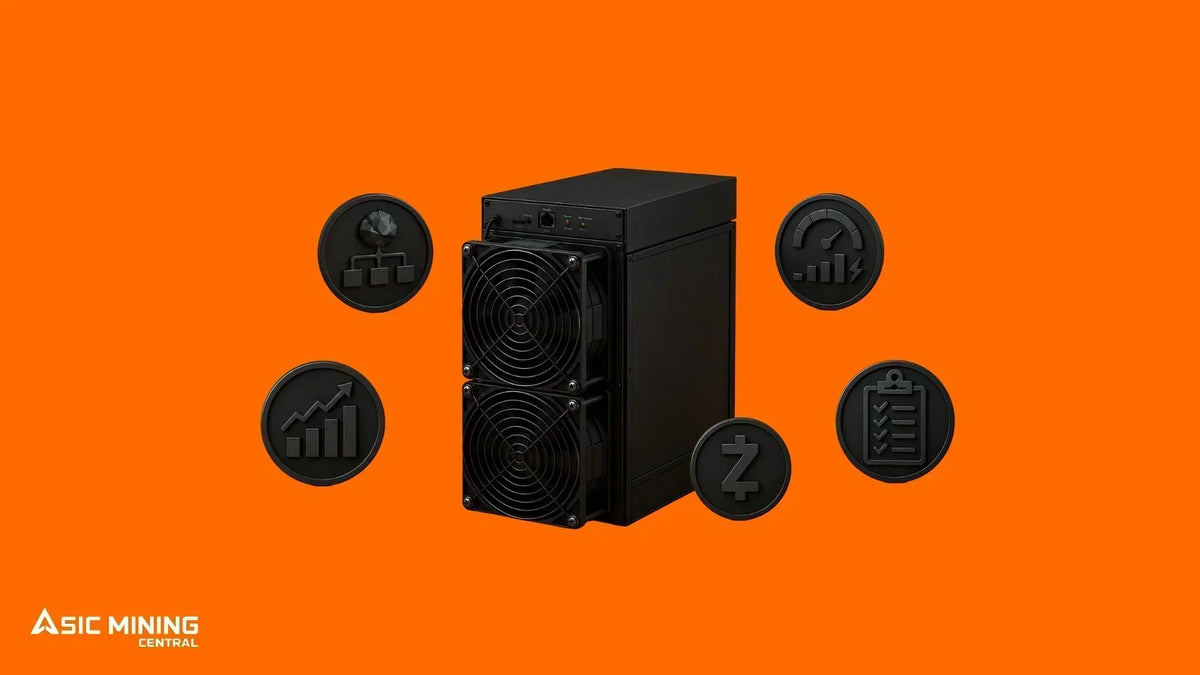
The Bitmain Antminer Z15K is designed for Equihash mining, with Zcash as its primary target. Its listed specs include 525 KSol/s hashrate, 2483W power use, and 4.73 J/KSol efficiency. These numbers give buyers a clear starting point, but they do not tell the full story by themselves.
In this guide, we will look at the Antminer Z15K. We will cover hashrate, power consumption, miner efficiency, electricity cost, mining returns, ROI planning, cooling, noise, setup needs, and the practical checks that matter before buying.
What Is the Bitmain Antminer Z15K?
The Bitmain Antminer Z15K is an ASIC miner built for the Equihash algorithm. It is mainly used for Zcash mining, which means it belongs to a specific mining category. It is not made for Bitcoin mining, and it should not be compared directly with SHA-256 machines.
That point is important. ASIC miners are not flexible like general computer hardware. Each machine is built for a certain algorithm. Bitcoin miners run on SHA-256, Litecoin and Dogecoin miners use Scrypt, and this model is built for Equihash.
So before checking daily returns or ROI, the first question is simple: does your mining goal match Equihash? If yes, the Z15K becomes worth reviewing.
For buyers interested in Zcash mining, the Z15K gives three useful numbers to start with: hashrate, power use, and efficiency. These help you understand what the machine can produce, what it may cost to run, and how practical it may be for your setup.

Why Should Buyers Review the Z15K Practically Before Buying?
A mining machine can look strong in a specification table, but real mining depends on more than listed hashrate. The actual result comes from how the machine runs in your environment.
This is where buyers need to slow down. A miner with good output can still be difficult to justify if electricity is expensive. A machine with solid specs can still create problems if the setup is hot, dusty, noisy, or not prepared for continuous power use.
For this reason, the Z15K should be reviewed through three angles.
- First, look at the machine itself: hashrate, power, efficiency, size, voltage, and noise.
- Second, calculate the running cost: electricity rate, pool fee, cooling cost, and expected uptime.
- Third, check whether your setup can support the miner: power, airflow, internet, placement, and monitoring.
This gives a more realistic buying view than looking only at one earning estimate.
What Are the Main Specifications of the Antminer Z15K?
The main specifications are useful because they explain what kind of machine the Z15K is and what kind of setup it may need.
|
Specification |
Details |
|
Manufacturer |
|
|
Model |
Antminer Z15K |
|
Algorithm |
Equihash |
|
Primary coin |
Zcash |
|
Hashrate |
525 KSol/s |
|
Power consumption |
2483W |
|
Efficiency |
4.73 J/KSol |
|
Weight |
9 kg |
|
Size |
133 × 245 × 290 mm |
|
Noise level |
72 dB |
|
Fans |
2 |
|
Interface |
Ethernet |
|
Voltage |
200–240V |
|
Operating temperature |
5–45°C |
|
Humidity |
5–95% |
These specs should not be read as separate points only. Together, they show the miner’s real profile. The hashrate tells you the output. The power consumption shows the daily energy demand. The efficiency shows how well the machine uses that energy. The noise level, voltage, size, and temperature range tell you what kind of placement and setup the miner may need.
The machine is not very large physically, but the 2483W power draw and 72 dB noise level are important. Those two points alone show that buyers should plan power and placement properly before running it.
What Does 525 KSol/s Hashrate Mean?
Hashrate shows how much mining work the miner can perform. For Equihash miners, this is measured in KSol/s. The Antminer Z15K is listed at 525 KSol/s, which gives buyers a clear performance base for Equihash mining.
But hashrate is not the same as profit. It only shows the machine’s mining capacity. The value of that capacity depends on ZEC price, network difficulty, pool performance, uptime, and electricity cost.
This is where many buyers make a quick mistake. They see a hashrate number, compare it with a calculator result, and assume that is the final answer. In reality, that is only the first step.
A better way to read the hashrate is this: 525 KSol/s tells you what the miner is built to deliver. After that, you still need to check how much it costs to keep that output running every day.
Why Does Equihash Matter Before Buying?
Before comparing returns, buyers should confirm the algorithm. The Z15K is an Equihash miner, so it should be compared with other Equihash mining machines, not with Bitcoin or Scrypt miners.
This matters because hashrate units are different across algorithms. Bitcoin miners are usually measured in TH/s. Equihash miners are measured in KSol/s. These numbers cannot be compared directly because they measure different types of mining work.
For Zcash mining, Equihash support is the main reason buyers would consider this miner. The coin, pool, wallet, and machine should all match the same mining direction.
In ASIC mining, this is a basic rule but still very important: choose the algorithm first, then compare the machines inside that category. That makes the comparison fair and useful.
How Much Power Does the Antminer Z15K Use?
Power consumption is one of the most important points in this miner. The Z15K uses 2483W, which means it runs at about 2.483 kW.
That number matters because mining machines usually run for long hours. They are not used like normal electronics that turn on and off occasionally. A miner stays connected to the pool and continues working, so power cost becomes a daily expense.
A simple formula helps buyers calculate daily electricity use:
Power in watts ÷ 1000 × 24 = daily kWh
For the Z15K:
2483 ÷ 1000 × 24 = 59.59 kWh per day
So if the miner runs for a full day, it may use around 59.59 kWh before adding extra cooling costs.
This is why power consumption should never be ignored. It directly affects the final return. A miner can show strong output, but if electricity cost is high, the net result can become much smaller.
How Can Electricity Cost Change the Final Mining Result?
The electricity rate can change the whole buying decision. The same miner may look practical in one location and less suitable in another only because the power rate is different.
|
Electricity Rate |
Estimated Daily Power Cost |
Estimated Monthly Power Cost |
|
$0.05 per kWh |
About $2.98/day |
About $89.40/month |
|
$0.07 per kWh |
About $4.17/day |
About $125.10/month |
|
$0.10 per kWh |
About $5.96/day |
About $178.80/month |
|
$0.12 per kWh |
About $7.15/day |
About $214.50/month |
|
$0.15 per kWh |
About $8.94/day |
About $268.20/month |
These are only electricity examples based on 59.59 kWh per day. They do not include pool fees, cooling costs, downtime, maintenance, or market changes.
Still, the table makes one thing clear. Even a small difference in power rate can create a large difference over time. This is why buyers should calculate returns with their own electricity cost instead of using a default number.
If the electricity rate is low, the miner has more room to work. If the rate is high, ROI needs to be checked more carefully.
Why Is 4.73 J/KSol Efficiency Important?
Efficiency shows how much energy the miner uses for its mining output. The Z15K is listed at 4.73 J/KSol. This gives buyers a useful way to compare the miner with other Equihash models.
A miner with better efficiency uses energy more effectively. This matters because mining is not only about earning revenue. It is also about controlling the cost of earning that revenue.
A simple way to understand it is:
Hashrate shows output. Power consumption shows electricity demand. Efficiency shows how well the machine balances both.
The Z15K’s efficiency number does not guarantee profit. No efficiency number can do that. But it helps buyers judge how practical the machine may be when electricity cost is added.
For long-term mining, miner efficiency becomes even more important when market conditions tighten. If ZEC price drops or network difficulty rises, a miner with better energy balance has more room to stay useful.
How Do Power and Efficiency Affect Mining Returns?
Mining returns depend on both the machine and the market. The machine side includes hashrate, power consumption, and efficiency. The market side includes ZEC price, network difficulty, pool fees, and competition.
The Z15K gives buyers a defined hardware profile: 525 KSol/s hashrate, 2483W power consumption, and 4.73 J/KSol efficiency. That makes it possible to estimate electricity cost and compare return scenarios.
But the final result is not the gross earnings number. Gross revenue is what the miner may earn before costs. Net return is what remains after electricity, pool fees, cooling, and downtime.
For buyers, net return is the number that matters more. A miner can show decent daily revenue, but if the power bill is high, the final amount left may not be strong.
So power and efficiency should be seen as part of the return calculation. They are not just technical specs. They directly shape the real mining result.
Why Are Mining Returns Always Changing?
Mining returns do not stay fixed. A miner can run at the same hashrate every day, but the earning estimate can still change.
That happens because the market keeps moving. ZEC price can rise or fall. Network difficulty can change. Pool performance may vary. Fees and rejected shares may also affect the final payout.
This is why buyers should not depend on one old calculator screenshot or one fixed daily estimate. Mining calculators are helpful, but only when they use current data and the buyer’s real electricity rate.
The Antminer Z15K gives a stable hardware base, but the value of its output changes with market conditions. That is why ROI should always be treated as an estimate, not a promise.
A practical buyer should check mining returns before purchase and keep checking after setup. This helps them understand whether the machine is performing close to expectations.
What Main Factors Affect Z15K Mining Returns?
The Z15K’s mining returns depend on several important factors:
- ZEC price: A higher coin price can improve revenue, while a lower price can reduce it.
- Network difficulty: Higher difficulty can lower the reward share for the same hashrate.
- Electricity rate: Power cost directly affects the amount left after expenses.
- Pool fees: Pool charges reduce the final payout.
- Miner uptime: A miner that disconnects or overheats earns less.
- Machine price: The buying price affects ROI and payback time.
- Cooling cost: Extra ventilation or cooling adds to operating cost.
- Maintenance: Dust, fan wear, and setup issues can affect performance.
These points should be checked together. A miner with good specs can still give weak results if the electricity rate is high or uptime is poor. A stable setup with controlled power cost can make the same machine look much more practical.
This is why experienced crypto miners usually look beyond daily revenue. They compare the full operating picture before deciding.
Is the Antminer Z15K Profitable?
The Antminer Z15K can be checked for profitability only with live mining data. The hardware specs are fixed, but profitability changes with ZEC price, difficulty, electricity cost, pool fee, machine price, cooling, and uptime.
On paper, the miner has a clear profile. It offers 525 KSol/s, uses 2483W, and gives 4.73 J/KSol efficiency. These specs are enough to start a calculation.
But no miner gives the same profit every day. Revenue can move up and down, while electricity cost continues as long as the miner is running.
A proper profitability check should include daily estimated revenue, daily power cost, pool fee, possible cooling cost, machine price, and expected payback time.
If the electricity rate is low and the machine price is reasonable, the return may look more practical. If electricity is expensive, the payback period can stretch longer.
So the better question is not only, “How much does it earn?” The better question is, “How much is left after costs?”
How Should Buyers Plan ROI Before Buying?
ROI means return on investment. In mining, it usually means how long it may take for the miner to recover its purchase cost through net mining returns.
The problem is that ROI is not fixed. It depends on many moving numbers. Coin price, network difficulty, pool fees, electricity cost, cooling cost, and uptime can all change the result.
For the Z15K, buyers should start with the known values: hashrate, power use, efficiency, and purchase price. After that, they should add their own electricity rate and current mining estimate.
A realistic ROI check should answer these questions:
- How much can the miner earn before costs?
- What will electricity cost each day?
- What is left after power and pool fees?
- How long may it take to recover the miner cost?
- What happens if returns fall or power cost rises?
These questions help buyers avoid over-optimistic planning. ROI should be checked with practical numbers, not only with the best-case estimate.
How Does Electricity Cost Affect ROI?
Electricity rates have a direct effect on ROI. Lower electricity cost leaves more room after the power bill. Higher electricity cost reduces the margin and can stretch the payback period.
|
Electricity Situation |
What It Means for ROI |
Buyer View |
|
Low electricity rate |
Better chance of stronger margin |
More room to manage market changes |
|
Medium electricity rate |
Needs careful calculation |
ROI depends more on ZEC price and difficulty |
|
High electricity rate |
Payback may take longer |
Margins can become tight quickly |
|
Extra cooling cost |
Adds to daily expense |
Should be included in real ROI |
|
Frequent downtime |
Reduces mining output |
Can delay payback |
This table shows that ROI is not only about the miner. It is about the miner inside a specific setup.
A buyer with low power cost may see the Z15K differently from a buyer with high electricity cost. A buyer with clean airflow and stable uptime may also get steadier results than someone running the miner in a hot or dusty area.
That is why ROI planning should always be based on the buyer’s real setup.
What Setup Does the Antminer Z15K Need?
The Z15K needs a proper mining setup. It should not be treated like a normal plug-and-play device. Buyers should prepare the power source, internet connection, pool details, wallet, airflow, and monitoring access before switching it on.
The miner uses Ethernet, so a wired connection is preferred. Stable internet helps the miner stay connected to the pool and submit shares without frequent errors.
Power setup also matters. Since the machine uses 2483W and supports 200–240V, buyers should confirm that their electrical setup is suitable. A weak socket or poor wiring is not a safe option for long mining hours.
Before starting, buyers should have the mining pool account, Stratum URL, worker name, Zcash wallet address, placement area, and dashboard access ready.
These steps may sound simple, but small setup mistakes can stop the miner from working properly. Wrong pool details, poor airflow, unstable internet, or weak power planning can affect performance and uptime.
How Should Buyers Plan Cooling and Placement?
Cooling is important because the Z15K produces heat while running. With 2483W power use, the miner needs a setup where hot air can move away clearly.
The intake side should receive cooler air, and the exhaust side should have a clear path for hot air. If hot air stays around the miner or returns toward the intake side, temperature can rise, and fans may work harder.
Placement should also allow easy checking. Buyers should be able to inspect cables, clean dust, check fan activity, and view dashboard readings without disturbing the whole setup.
A good mining area should be clean, open, ventilated, and stable. A poor setup is usually cramped, dusty, hot, and blocked from airflow.
Cooling is not only about protecting the machine. It also supports uptime. A miner that runs in a better temperature range is more likely to stay stable.
Is the Z15K Noise Level Suitable for Every Setup?
Noise should be checked before installation. The Z15K has a listed noise level of 72 dB, which means it needs a suitable placement area.
This kind of miner is usually not ideal for a bedroom, office, or quiet living area. It is better placed in a garage, utility room, mining room, warehouse, or hosted setup.
Noise can also increase if the room gets hot. Poor airflow can make fans work harder, and that can make the miner louder. This is why noise planning and cooling planning should be done together.
Before buying, think about the daily reality. Will the sound disturb people? Will it travel into nearby rooms? Is there a separate space where the miner can run without causing issues?
A miner can have strong specs and still be difficult to live with if it is placed in the wrong location.
Why Do Pool Setup and Network Stability Matter?
Mining performance also depends on pool connection. The Z15K uses Ethernet, so buyers should plan for a stable wired network.
The miner needs to connect to a pool, receive mining work, and submit shares. If the connection drops often, the miner can show errors, rejected shares, or downtime.
Before setup, buyers should prepare the pool account, Stratum URL, worker name, and Zcash wallet address. These details should match the coin and algorithm. A wrong pool URL or wallet detail can stop the miner from working correctly.
The internet connection does not need to be extremely fast. It needs to be stable. A good Ethernet cable, reliable router, and proper network setup can reduce unnecessary mining issues.
Mining is not only about hardware. The network helps keep the miner online and productive.
Who Should Consider the Antminer Z15K?

The Z15K is mainly for buyers who are focused on Equihash mining. It is not a general miner for every coin, so the mining goal should be clear before buying.
This miner can make sense for buyers who want to mine Zcash, compare dedicated Equihash hardware, and have access to a suitable electricity rate. It may also suit users who already understand pool setup, wallet setup, and ROI planning.
It may be less suitable for buyers who want silent home mining, very low power draw, or Bitcoin mining. It may also be harder to justify for buyers with high electricity costs or poor ventilation.
The best buyer for this machine is someone who checks both the specs and the running cost. The Z15K gives a clear hardware profile, but the setup decides whether it becomes practical.
How Should Buyers Compare the Z15K Before Buying?
The Z15K should not be compared by hashrate only. A better comparison starts with the algorithm, then moves to performance, cost, and setup.
First, confirm that Equihash mining matches your goal. Then check the hashrate and power use together. After that, calculate electricity cost and review mining returns using live data. Finally, check setup needs such as cooling, noise, voltage, and internet stability.
This step-by-step method helps buyers avoid emotional decisions. A strong hashrate can look attractive, but mining is a long-term activity. Daily cost decides the real outcome.
The Z15K may fit well when the buyer has proper power, suitable electricity cost, and a mining space that can handle heat and noise. It may be less practical when power is expensive, or the setup area is not ready.
What Common Buyer Mistakes Should Be Avoided?
The first common mistake is judging the miner only by hashrate. Hashrate matters, but it does not show the final amount left after costs.
Another mistake is using old profitability estimates. Mining conditions change, so a past estimate may not match the current market.
Buyers should also avoid rushing the setup. A miner with strong specs can still struggle in a hot room, on unstable internet, or with blocked airflow.
Common mistakes include:
- Checking only hashrate and ignoring power cost
- Using old profitability estimates
- Not confirming Equihash pool support
- Ignoring electricity rate before buying
- Forgetting to include pool fees and cooling cost
- Placing the miner in a poor airflow area
- Underestimating the 72 dB noise level
- Not checking voltage support
- Expecting fixed daily profit
- Skipping ROI planning
These mistakes are avoidable. A better buying decision comes from connecting the product specs with the buyer’s real setup and current mining conditions.
What Is the Practical Buying View for the Z15K?
The Z15K should be viewed as a dedicated Equihash miner with clear performance numbers. It is not a machine buyers should choose only because the specs look strong. It needs the right power rate, mining goal, and setup.
Its strength is that the key numbers are clear. Buyers know the hashrate, power use, and efficiency. That makes it easier to estimate power cost and compare return scenarios.
But the final decision always comes back to the buyer’s situation. If the electricity rate is suitable and cooling is planned, the miner may look practical. If electricity is expensive or the setup space is limited, ROI can become harder to justify.
So the best buying view is balanced. The Z15K can be a serious Equihash option, but it still needs the right operating conditions.
Conclusion
The Bitmain Antminer Z15K is a dedicated Equihash mining machine with 525 KSol/s hashrate, 2483W power consumption, and 4.73 J/KSol efficiency. These specs make it relevant for buyers looking at Zcash mining, but the real value depends on electricity cost, machine price, pool fees, cooling, uptime, and current mining returns.
Before buying, buyers should compare the full operating cost instead of judging the miner only by hashrate. A machine can look strong on paper, but the final result depends on how much it costs to run each day and how well the setup supports it. For buyers who want to review suitable mining hardware with clear product details and practical options, ASIC Mining Central can be a useful place to compare options before making the final decision.
Share:
What Makes an ASIC Miner Suitable for Home Mining?
What Is Blake2B-Sia Mining and How Does It Work?